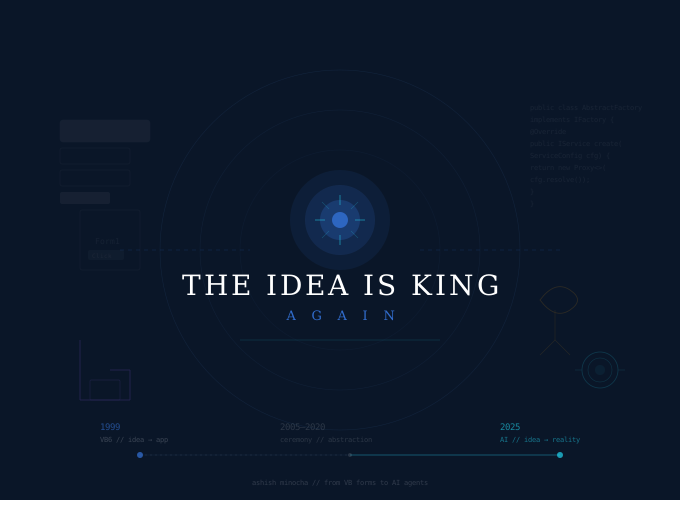
It was 1999. I was walking out of college with a head full of ideas and a copy of Visual Basic on my machine. And honestly, that was all I needed.
VB was beautiful. Not in the way architects or purists would define beautiful. It was beautiful because it disappeared. You had an idea at 10 AM, and by lunch, you had a working application. A form here, a button there, a few lines of code behind it, and suddenly your idea was alive, running, doing things. The distance between thought and thing was almost zero.
I remember dragging a TextBox onto a form, double-clicking a CommandButton, writing maybe fifteen lines of code, and watching something real happen on screen. No build pipelines. No dependency injection. No twelve-layer abstraction. Just intent, translated directly into outcome.
Then the world decided this was too simple.
The Era of Ceremony
Somewhere along the way, someone decided that software needed more rigour. More structure. More ceremony. Object-oriented programming arrived, and with it came a tidal wave of classes, interfaces, inheritance hierarchies, design patterns, and architectural frameworks that turned a simple idea into a six-month expedition.
Don't get me wrong. OOP solved real problems. Enterprise systems needed that discipline. But for someone who fell in love with programming because ideas could become applications in an afternoon, it felt like the joy had been engineered out of the process.
The craft became about the tooling, not the thinking. You spent more time configuring your environment than building your vision. The idea, once king, had been dethroned by process.
So I did what made sense. I walked away from the keyboard. Not entirely, not from technology. But from that particular kind of magic.
Finding Craft Elsewhere
I picked up a chisel. Then a router. Then a table saw. Carpentry gave me back what programming had taken away. You imagine a shelf, you measure the wood, you cut it, you join it, and by evening it exists in the physical world. Idea to object. No middleware required.
Photography did something similar. You see a frame, you compose it, you press the shutter. The gap between vision and output is one decisive moment.
Motorcycling taught me a different lesson. When you are leaning into a curve at speed, there is no room for abstraction. It is just you, the machine, and the road. Pure, unmediated experience. Thought and action, fused.
These weren't hobbies. They were the same impulse that made me fall in love with VB in 1999. The impulse to think something and then make it real, without fifty steps of ceremony in between.
Then the AI Bug Bit
Fast forward twenty-five years. I am sitting in front of a screen again. But this time, something has changed.
I describe what I want in plain language. Not in syntax. Not in a class diagram. Not through three layers of abstraction and a design review. I just say what I am thinking. And it builds.
The first time I watched an AI agent take a rough idea and turn it into a working prototype, I felt something I had not felt since 1999. That same electricity. That same collapse of distance between imagination and reality.
AI has not just changed the tools. It has restored the original promise.
The idea is king again.
What This Means for Builders
I have spent twenty-five years in technology delivery, leading large engineering teams, shipping complex applications at scale. I have deep respect for software engineering discipline. We need architecture. We need patterns. We need rigour for systems that serve millions of users.
But I have also watched brilliant people with brilliant ideas get crushed under the weight of process before they could even prove the idea had merit. The cost of experimentation became so high that most experiments never happened.
AI is resetting that equation. Today, a product manager with a clear idea can have a working prototype before the sprint planning meeting. A designer can go from sketch to functional interface in hours, not weeks. A developer can focus on what the system should do rather than how to wire it together.
We are not going back to VB. We are going somewhere better. A place where decades of engineering wisdom still applies, but the barrier between idea and first working version has collapsed to nearly zero.
For those of us who remember what it felt like to drag a button onto a form and watch an idea come alive, this moment feels like coming home.
The tools have changed. The languages have changed. The platforms have changed.
But the magic? The magic is back.
I lead large-scale digital product engineering. I build software, furniture, and occasionally ride motorcycles into curves faster than advisable.