There was a time when experience felt like insurance. If you stayed long enough and did good work, your career would take care of itself.
That logic doesn't hold anymore.
Today, the same experience that once made you valuable can quietly make you expensive, slower to adapt, or easier to replace. Especially in an environment where companies like Oracle are constantly optimizing for efficiency, and increasingly, for what AI can do faster and cheaper.
This isn't about fear. It's about awareness.
Because the real risk today isn't layoffs. It's not noticing how the definition of value is changing until it's too late.
What's Actually Changing
This shift is not just about cost cutting. It's about how work itself is evolving.
AI is making a lot of things easier. Writing, coding, analysing, building presentations. Tasks that once needed years of experience can now be done with the help of tools.
So companies are starting to ask a different question. Not "who can do this?" but "do we even need a person to do this?"
And that changes everything.
The gap today is no longer between junior and senior professionals. It's between people who are comfortable working with AI, and people who are not.
Where the Real Value Lies Now
If AI can do more of the doing, then where does that leave us?
The answer is simple, but not easy.
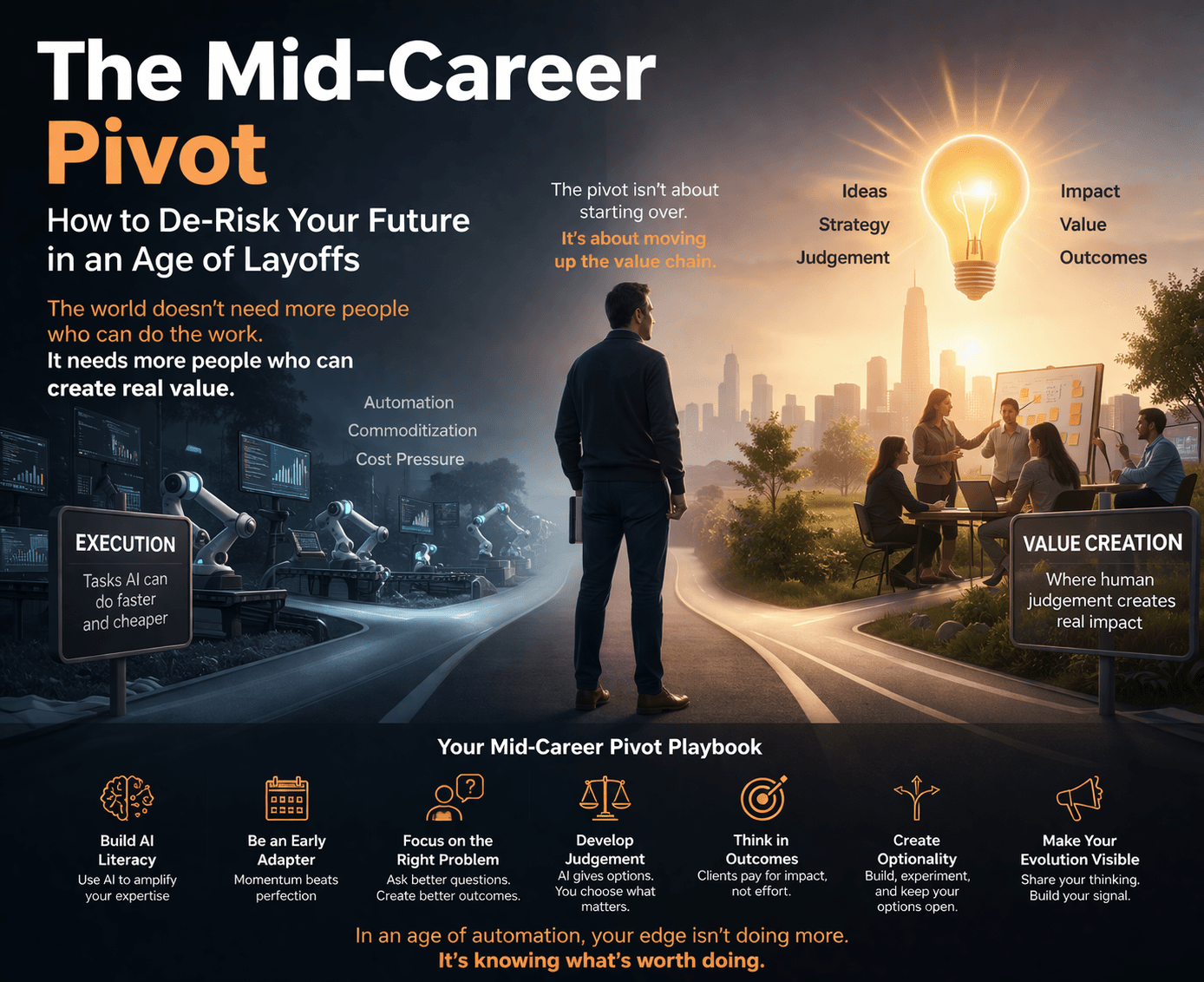
Value is moving away from execution and towards definition.
AI can generate output. But it still struggles with things like:
- Deciding what should be built
- Understanding why something matters
- Figuring out what will actually create value for a client
That is still very human work.
And that is where the opportunity is.
A Simple Way to Look at It
Think of work today in three layers.
1. Execution (Lowest Moat)
- Writing code
- Creating decks
- Running analysis
AI is getting very good here, very fast.
2. Orchestration (Medium Moat)
- Managing workflows
- Coordinating teams and tools
- Ensuring delivery
Still valuable, but becoming more standardised.
3. Value Creation (Highest Moat)
- Understanding the real problem
- Making judgement calls
- Connecting effort to outcomes
This is where humans still dominate.
The Question You Should Be Asking Yourself
It is not "am I safe?"
It is "where am I operating?"
If most of your work is execution, you are competing with tools. If most of your work is orchestration, you are still relevant, but that space is getting crowded.
If you are creating value, you are harder to replace.
Why People Fall Behind Without Realising It
This kind of disruption rarely feels dramatic.
It shows up quietly.
- You take a little longer to do things
- Someone else delivers faster using AI
- You get pulled into fewer strategic conversations
- You are seen as reliable, but not essential
And over time, that gap becomes hard to close.
So What Does a Mid-Career Pivot Actually Look Like
This is not about starting over. It is about shifting how you operate.
1. Start Using AI to Amplify Your Experience
Experience still matters. But on its own, it is no longer enough.
The people pulling ahead are not the ones who know the most. They are the ones who can combine what they know with what AI can do.
- Use AI to speed up execution
- Free up your time to think, decide, and guide
2. Build Real AI Literacy
Using tools occasionally is not enough.
You need to understand:
- Where AI helps and where it doesn't
- How to integrate it into your daily work
- How to question what it produces
This is less about tools and more about mindset.
3. Be Early, Even If You're Imperfect
Most people wait until something becomes standard.
By then, the advantage is gone.
Right now, you don't need to be an expert. You just need to be curious and willing to try.
4. Spend More Time on the Problem
Stop jumping straight into execution. Start asking better questions.
- What are we actually trying to solve?
- What outcome matters here?
- Is this even the right approach?
The more time you spend here, the more valuable you become.
5. Develop Judgement and Taste
AI can give you ten options.
It cannot tell you which one is right.
Your edge becomes:
- What you choose
- What you reject
- What you refine
6. Think in Terms of Outcomes
Instead of saying:
"I delivered this"
Start thinking:
"What changed because of this?"
Clients do not care about effort. They care about impact.
7. Create Options for Yourself
AI makes it easier than ever to experiment.
- Explore ideas
- Build small projects
- Test new directions
Not to quit your job, but to prove you can create value outside of it.
8. Let People See That You're Evolving
If no one can see how you are growing, they assume you are not.
- Share what you are learning
- Talk about how your work is changing
- Build a point of view
The Mindset Shift That Matters
Earlier, the goal was stability.
Now, the goal is flexibility and leverage.
You want to be someone who can move, adapt, and stay relevant across changes.
That comes from combining:
- Experience
- AI literacy
- A strong sense of value creation
A Final Thought
If you are over 40, you are not at a disadvantage.
You are at a point where you can either:
- Continue doing what has worked so far
- Or evolve how you work to stay ahead
The difference is not age. It is awareness and action.
Because in a world where more and more people can execute, the real advantage comes from knowing what is worth executing in the first place.