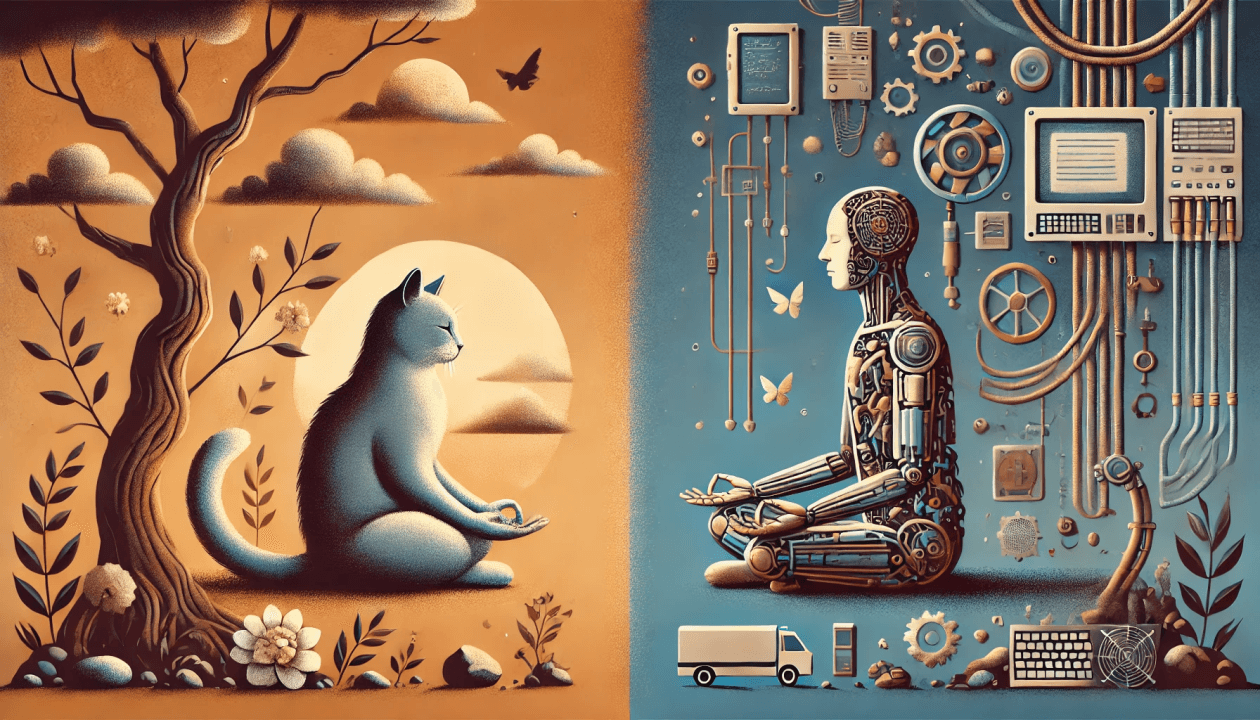
My cat Freya is a philosopher.
She doesn't know it, of course. She simply is — curled in a patch of afternoon light, completely absorbed in the warmth of the moment. No anxiety about tomorrow's agenda. No replaying yesterday's mistakes. Just presence, pure and uncomplicated.
I've spent the better part of 25 years in technology transformation — a field built on the premise that more capability, more intelligence, more progress is always better. And yet, watching Freya, I find myself questioning the very premise of what it means to evolve.
The Question We Never Ask
We celebrate human exceptionalism almost reflexively. We invented language, built civilisations, mapped the genome, sent probes beyond the solar system. By every metric we've defined for ourselves, we are the apex.
But who wrote those metrics?
We did. And in doing so, we've defined "progress" almost entirely as an outward expansion — more knowledge, more control, more reach. We've said almost nothing about inner balance, about the quality of our lived experience, about whether all this accumulation actually makes us well.
What Freya Knows
Freya has no existential dread. She doesn't scroll through a feed that's been algorithmically tuned to make her outraged. She doesn't lie awake manufacturing worries about things that may never happen. She doesn't need external validation to feel that her existence has value.
She eats when she's hungry, rests when she's tired, plays when energy moves through her. She is, by any meaningful measure of moment-to-moment wellbeing, doing better than most people I know — including, on many days, myself.
That's not a romanticisation of animal life. Freya doesn't have antibiotics or the ability to call a plumber. Trade-offs exist. But the question isn't whether we should abandon our capabilities. It's whether we've mistaken capability for flourishing.
The Disconnection Tax
Here is what I observe in organisations and in myself: every layer of abstraction we add between ourselves and direct experience — every notification, every dashboard, every optimised workflow — costs something. That cost is paid in presence.
We've built an entire civilisation on the art of deferring the present moment. We're perpetually preparing for a future that, once it arrives, we're too distracted to inhabit.
The great traditions — Stoic, Buddhist, Vedantic — all arrived independently at the same conclusion: the ability to be fully here is not a passive default but a discipline, and perhaps the highest one. It's remarkable that we've had to construct entire spiritual technologies to recover something a cat never lost.
Progress Worth Having
I'm not arguing against knowledge or ambition. I'm arguing for an honest accounting of what we gain and what we spend.
True progress, I think, looks like this: expanding capability without losing coherence. Building systems that serve human flourishing rather than cannibalise human attention. Knowing more and feeling more anchored, not less.
The measure of a genuinely advanced civilisation might not be how far it can reach outward, but how well it can rest in itself.
Freya is asleep now, one paw draped over her nose. She looks, as she always does, entirely satisfied.
I'm taking notes.