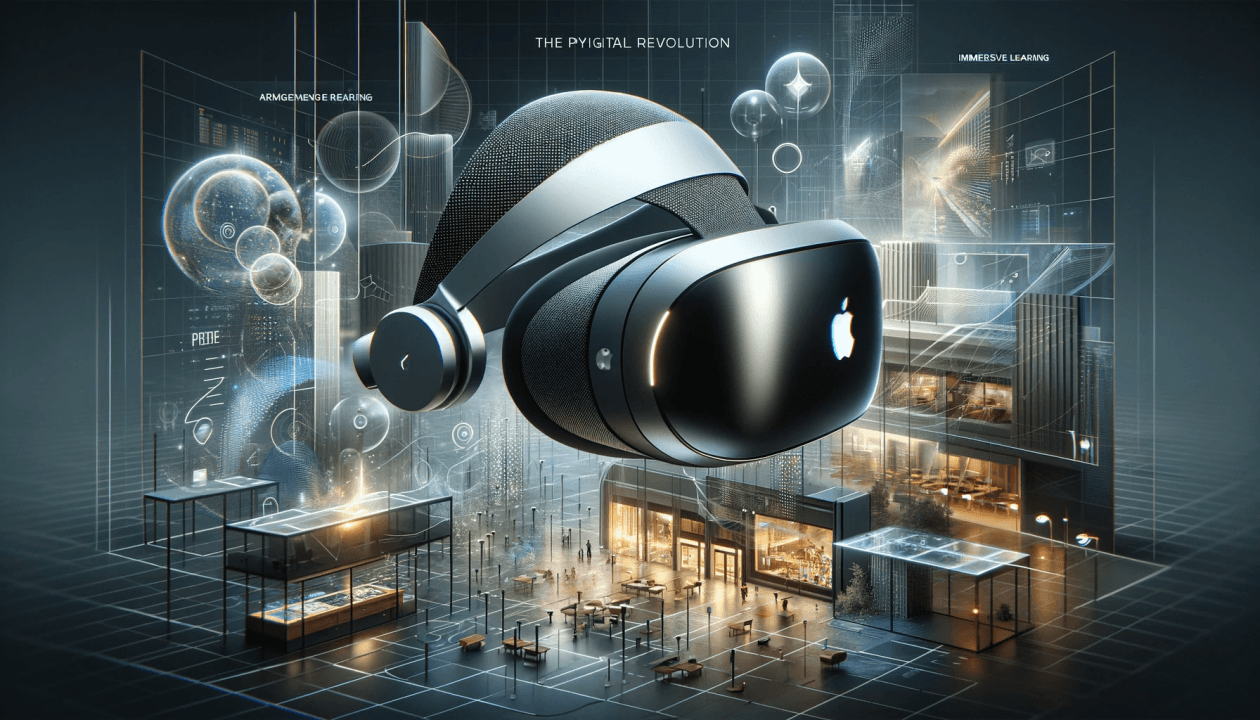
On the day Apple shipped Vision Pro, I cleared my afternoon and spent several hours with the device. What follows are my honest impressions — not as a gadget reviewer, but as someone who has spent years thinking professionally about what immersive technology means for how organisations work, communicate, and deliver.
First Impressions: The Display is the Argument
You can read the specs. You can watch the promotional material. Neither prepares you for what the display actually looks like when you put it on.
The micro-OLED panels in Vision Pro produce an image with a pixel density that, at normal viewing distances, is effectively indistinguishable from reality. Text is sharp. Colour is accurate. The transition between the virtual overlays and the physical world is seamless in a way no other device has achieved.
For those of us who have been following immersive tech for years, this is significant. The "screen door effect" — the visible pixel grid that broke immersion in earlier headsets — is simply gone. What remains is something that genuinely feels like a window onto an extended version of your own space.
The Input Paradigm
Apple made a deliberate choice to rely entirely on eyes, hands, and voice — no controllers. This was a risk. Controllers are imprecise but learnable. Natural input is intuitive but demands a level of accuracy from the device that's harder to achieve.
In practice, it works. The eye tracking is precise enough that you can accurately target UI elements I would have expected to require a physical pointer. The pinch gesture to select is quick to learn and reliable in execution. After an hour, I stopped thinking about the input method and started thinking about what I was doing with it.
That invisibility of interaction is exactly what Apple was aiming for, and they've achieved it.
The "Phygital" Premise
The concept I keep returning to when thinking about Vision Pro is "phygital" — the blending of physical and digital experience into something that doesn't cleanly belong to either.
Previous AR devices asked you to hold up a phone or look through a constrained viewport. Vision Pro inverts this: your physical world is the viewport, and digital content inhabits it. Your kitchen table can have a browser hovering above it. Your living room can host a cinema screen sized to fit the available space. Your colleague in another city can appear sitting across from you in a virtual meeting room that looks like a real one.
The philosophical shift is significant. We've spent decades asking people to leave the physical world and enter a digital one. Vision Pro asks something different: it asks the digital world to enter ours.
What It Means for the Enterprise
The use cases I find most compelling are not consumer entertainment but professional application.
Consider design review: a product team distributed across three cities, examining a full-scale 3D prototype together in a shared spatial environment, able to walk around it, annotate it in real time, and discuss it as if they were in the same room with the physical object. That experience exists on Vision Pro today. It is meaningfully better than a video call with a rotating 3D model on a flat screen.
Consider field service: an engineer on-site wearing a device that overlays live diagnostic data onto the equipment they're working on, with a remote expert able to see exactly what they see and annotate their field of view in real time. The reduction in error rates and resolution time in early pilots of this model has been substantial.
Consider training: a medical student practising a procedure in a simulated environment with the fidelity to make the practice genuinely transferable to real-world performance.
These aren't hypothetical. They're happening, at various stages of maturity, on spatial computing platforms today.
The Long Game
Vision Pro at $3,500 is not a mass-market device. Apple knows this. The first iPhone was not mass market either.
What Vision Pro represents is Apple's declaration of the platform they intend to build. The device will get lighter, cheaper, and more capable over successive generations. The developer ecosystem will mature. The use cases will proliferate and become more specific and more compelling.
The organisations that begin building fluency with spatial computing now — that develop internal capability, that pilot use cases, that learn from early deployment — will have a significant advantage when the technology reaches the inflection point of mainstream adoption.
We are at the beginning of something that will, over the next decade, reshape significant portions of how knowledge work gets done. Vision Pro is the opening move.
It is a remarkable opening move.